
AI Benefits Of Using Mathematical Graphs To Orchestrate AI Vs. LLMs For B2B Procurement
How Send 123 helps businesses save money and control costs
The landscape of corporate purchasing is undergoing a seismic shift. For decades, procurement teams have been bogged down by manual processes, endless spreadsheets, and disconnected enterprise resource planning (ERP) systems. Today, we are witnessing the dawn of a new era, driven by artificial intelligence. However, as organizations rush to adopt the latest technologies, a critical debate has emerged: what is the most effective AI architecture for managing complex supply chains and corporate spend?
While Large Language Models (LLMs) like ChatGPT have captured the public’s imagination, they often fall short when tasked with the rigorous mathematical and logical demands of enterprise purchasing. Enter the strategic approach of using mathematical graphs to orchestrate AI, a structured, deeply connected architecture that maps the exact relationships between suppliers, contracts, and market dynamics.
In this comprehensive guide, we will explore the immense AI benefits for B2B procurement. We will dissect the critical differences between conversational LLMs and deterministic graph-orchestrated AI, and reveal how innovative platforms like Send 123 are leveraging these technologies to help businesses save money, streamline operations, and aggressively control costs.
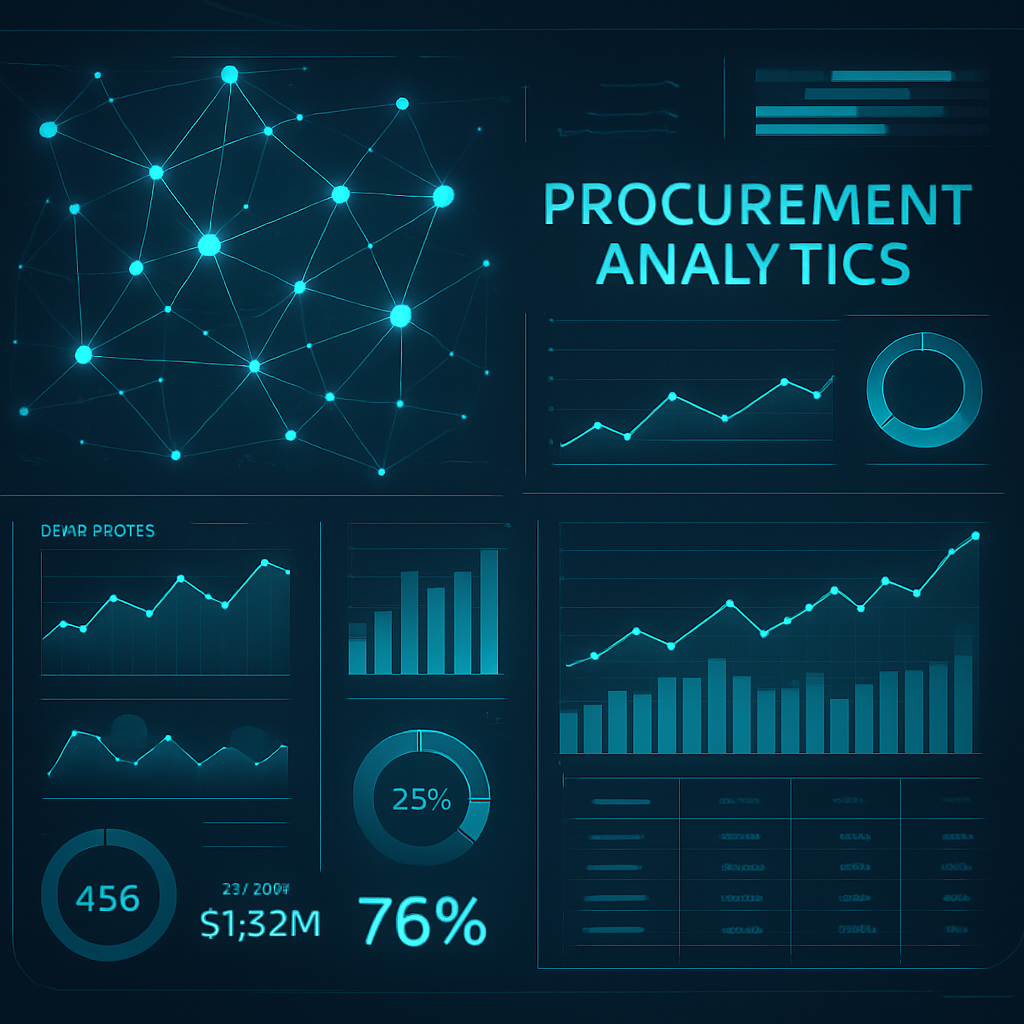
The Evolution of Purchasing: From Manual to Cognitive
To truly appreciate the modern benefits of AI, we must first look at how far the industry has come. Historically, procurement was viewed merely as a back-office function, a tactical department responsible for processing purchase orders and negotiating basic discounts.
When comparing cognitive procurement vs. traditional purchasing methods, the differences are staggering. Traditional methods relied heavily on static, rule-based systems. A buyer would identify a need, manually request quotes from three known suppliers, negotiate over weeks of email back-and-forths, and eventually sign a contract. This approach was inherently flawed:
- Siloed Data: Purchasing data lived in separate departments.
- Reactive Decision-Making: Buyers only reacted to requests rather than anticipating needs.
- Human Error: Manual data entry led to duplicate payments and missed contract renewals.
Cognitive procurement, on the other hand, acts as an intelligent partner. It uses continuous data streams to learn, reason, and adapt. It doesn't just execute commands; it advises procurement officers on the best course of action. Utilizing AI for procurement transforms the department from a cost center into a strategic value generator, fundamentally altering how organizations interact with global supply chains.
The Great AI Debate: Mathematical Graph Orchestration vs. LLMs
If you want to understand the true AI benefits for B2B procurement, you must understand the engine under the hood. Not all AI is created equal. The current technology market is heavily focused on Large Language Models (LLMs), but relying solely on an LLM for enterprise purchasing can be a costly mistake.
The Limitations of LLMs in Procurement
LLMs are probabilistic engines. They are trained to predict the next logical word in a sentence based on vast amounts of training data. They are phenomenal at drafting emails, summarizing long documents, and brainstorming ideas.
However, they suffer from critical flaws when applied to strict business logic:
- Hallucinations: LLMs can confidently invent facts. In procurement, a hallucinated price, supplier compliance status, or contract clause can lead to legal and financial disaster.
- Lack of Mathematical Rigor: LLMs struggle with complex spend calculations across multiple currencies and tax brackets.
- No Structural Memory: They do not inherently "understand" the relationship between a parent company and its subsidiaries, or how a specific part fits into a broader bill of materials (BOM).
The Power of Using Mathematical Graphs to Orchestrate AI
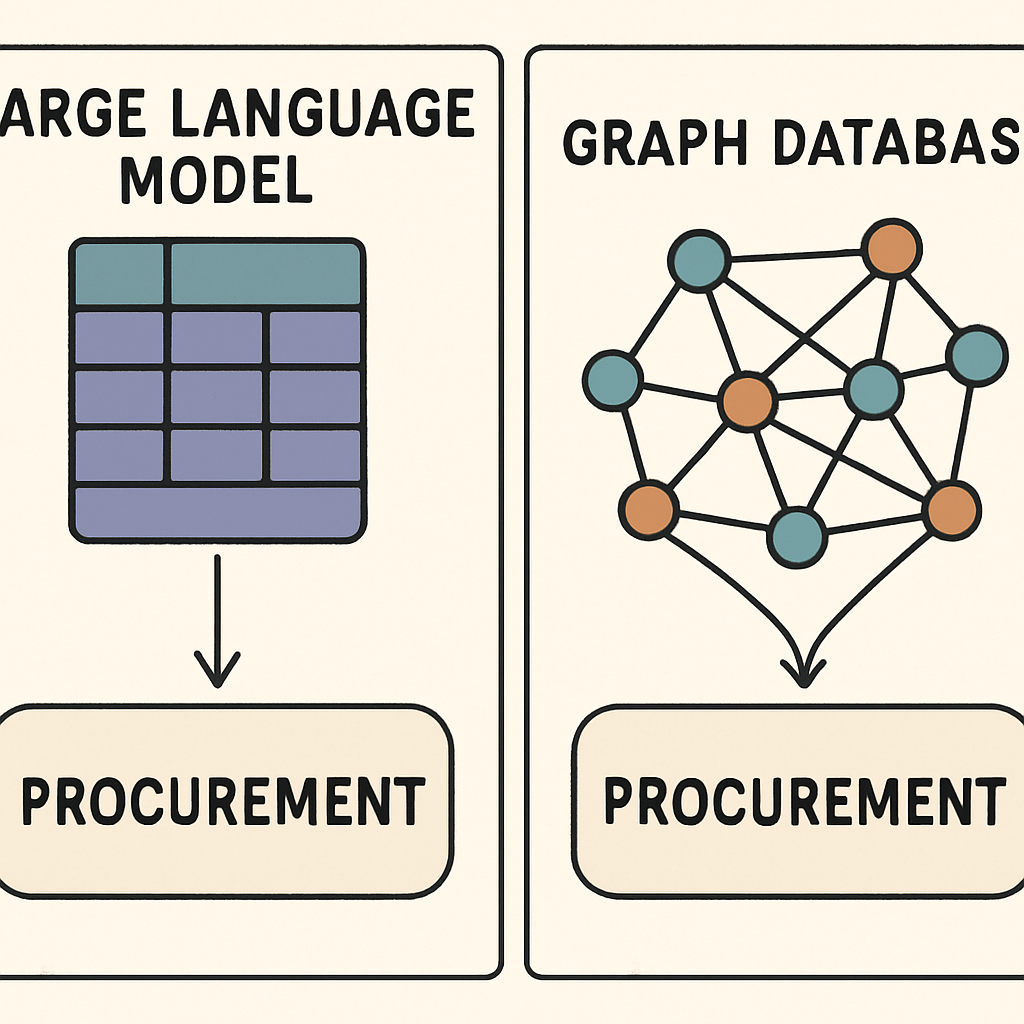
Using mathematical graphs to orchestrate AI operates fundamentally differently. It maps data deterministically using "nodes" (entities like a Supplier, a Contract, or a Product) and "edges" (the mathematical and structural relationships between them).
When mathematical graphs orchestrate your AI workflows, the system inherently knows that:
- Supplier A (Node) is the parent company of Supplier B (Node) via an explicit relationship (Edge).
- Product X (Node) requires Raw Material Y (Node).
- Contract Z (Node) expires on December 31st (Node).
This deterministic approach ensures 100% accuracy for execution. When you pair conversational natural language parsing with mathematical graphs to orchestrate AI, you get the ultimate procurement tool. This is exactly the architecture that modern solutions like Send 123 use to ensure flawless execution and deep strategic insights.
Core AI Benefits for B2B Procurement
With a robust mathematical graph orchestration foundation in place, the operational benefits become limitless. Organizations can move past basic task automation and enter a realm of hyper-efficiency. Let’s explore the specific ways AI is revolutionizing the purchasing ecosystem.
1. Achieving Unprecedented Spend Visibility
One of the most immediate advantages of implementing an intelligent procurement system is gaining total visibility into where your organization's money is going.
Automated spend analysis for enterprise sourcing is a game-changer. Traditionally, spend analysis required teams of analysts to manually pull data from disparate ERPs, clean it in Excel, and attempt to categorize it, a process that often took months, rendering the data obsolete by the time it was reviewed.
An AI engine orchestrated by mathematical graphs automates this entirely. It ingests millions of line items from invoices, purchase orders, and corporate credit cards in real-time. It cleans the data, translates descriptions, and categorizes every penny according to standard taxonomies (like UNSPSC). This level of automated spend analysis for enterprise sourcing allows Chief Procurement Officers (CPOs) to instantly identify consolidation opportunities, uncover duplicate payments, and negotiate better volume discounts across the entire enterprise.
2. Eliminating Rogue Spending
Maverick spend, purchases made outside of agreed-upon contracts and procurement policies, is a silent killer of corporate profit margins. It bypasses negotiated discounts, ignores compliance checks, and obscures cash flow visibility.
Reducing maverick spend through smart automation is one of the most immediate ways Send 123 helps businesses control costs. By utilizing an intuitive, consumer-like purchasing interface powered by mathematical graph logic, employees are naturally guided toward preferred suppliers.
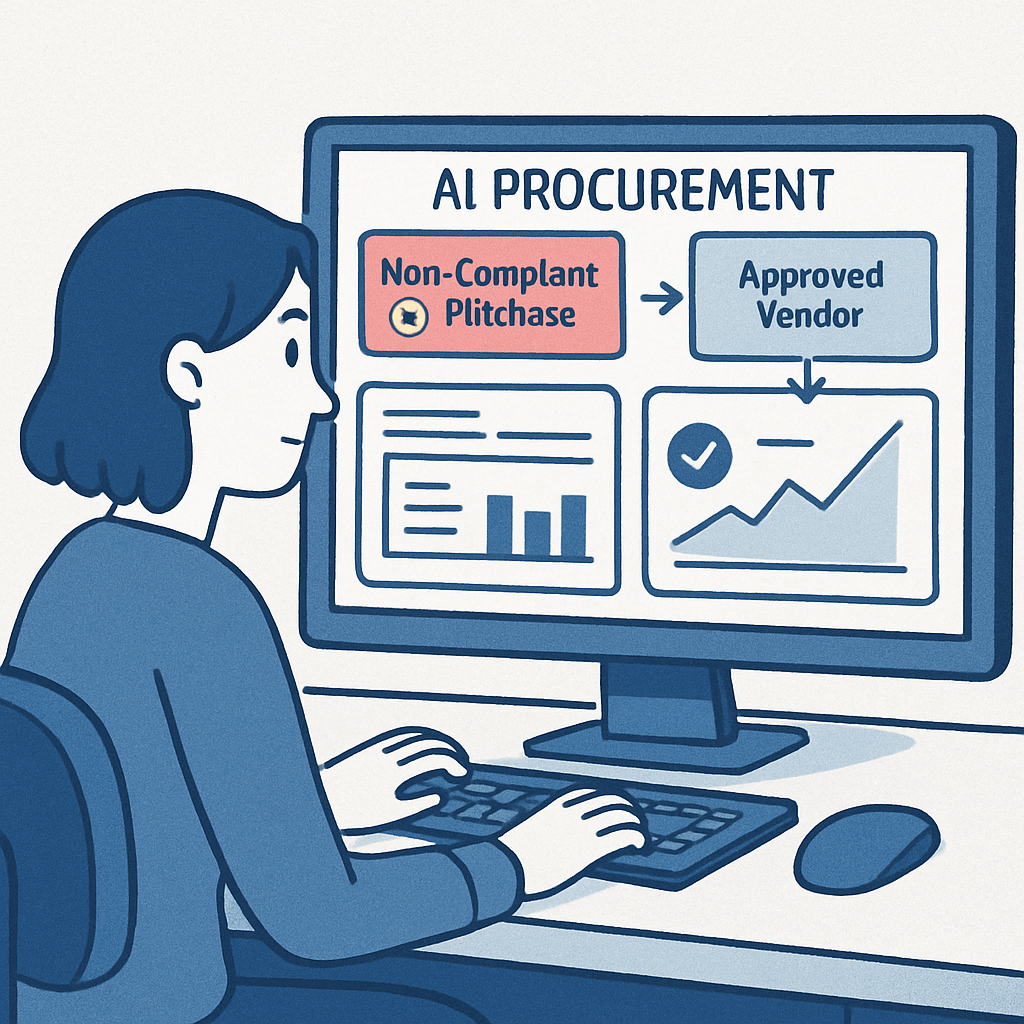
If an employee attempts to buy a high-end laptop outside of the approved IT catalog, the smart automation system can:
- Instantly flag the purchase.
- Automatically suggest the approved equivalent from a contracted supplier.
- Route the rogue request to a manager with context on how much money the company will lose by not using the preferred vendor.
Reducing maverick spend through smart automation not only saves money but dramatically improves internal compliance without frustrating end-users.
Supply Chain Resilience and Risk Management
In today’s volatile global market, saving money is only half the battle. Protecting the organization from supply chain disruptions, vendor bankruptcies, and compliance violations is equally critical.
Advanced Risk Mitigation
Assessing the viability of a new supplier used to involve pulling a simple credit report. Today, machine learning for vendor risk assessment takes a holistic, multi-dimensional approach.
AI orchestrated via mathematical node paths can continuously monitor a vast web of global data points. It analyzes news sentiment, tracks geopolitical events, monitors cybersecurity ratings, and evaluates financial health indicators in real-time. By utilizing machine learning for vendor risk assessment, the system can alert a procurement team that a key supplier in Southeast Asia is facing severe weather disruptions or that a software vendor has just suffered a massive data breach, allowing the company to pivot to backup suppliers before a disruption occurs.
Supplier Performance Tracking
How do you know if your suppliers are actually delivering on their promises? Relying on quarterly business reviews (QBRs) is no longer sufficient. Businesses need real-time supplier performance monitoring tools to hold vendors accountable.
AI systems track every interaction with a supplier. They measure on-time delivery rates, quality defect percentages, invoice accuracy, and responsiveness. These real-time supplier performance monitoring tools feed directly into the graph architecture, dynamically adjusting a supplier's overall "health score." If a vendor's quality begins to dip, the AI can automatically trigger a performance improvement plan or begin sourcing alternative suppliers.
Future-Proofing with Predictive Analytics
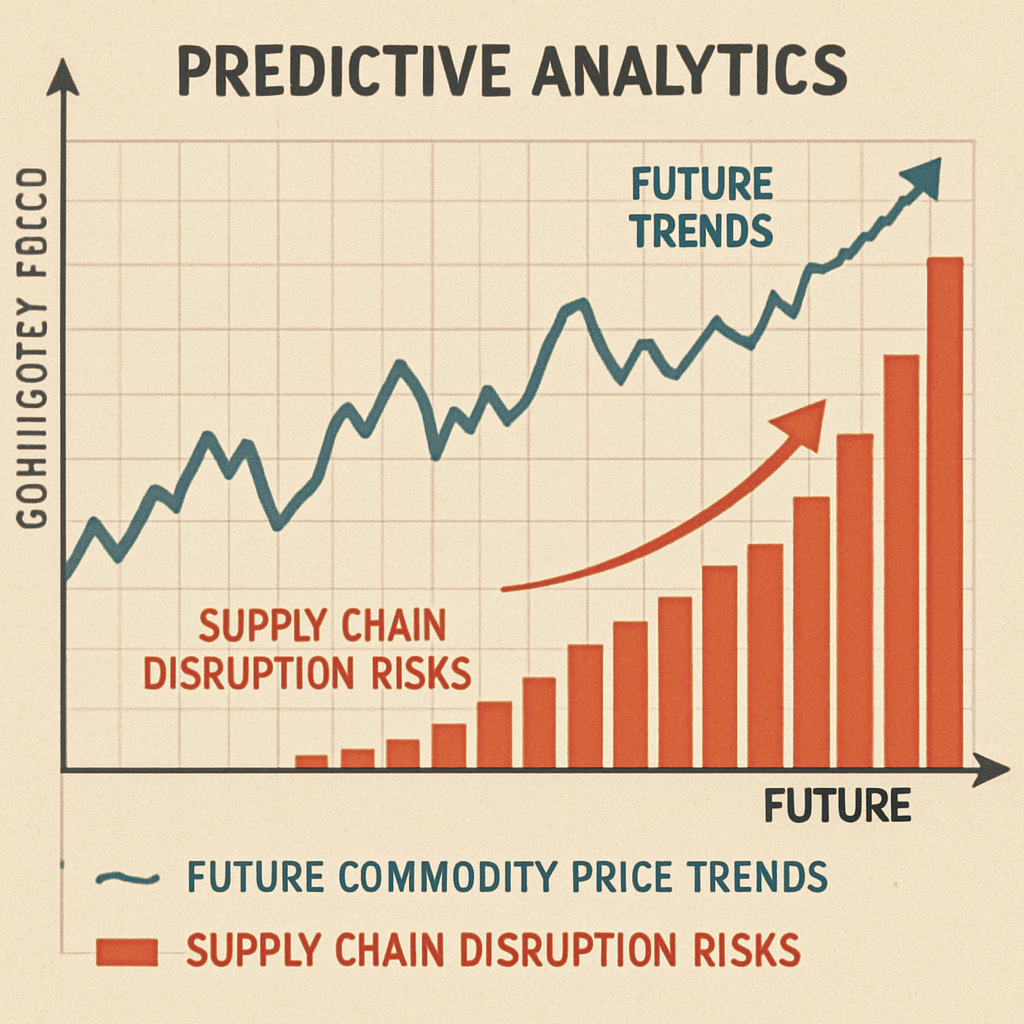
Why react to the market when you can anticipate it? Predictive analytics in supply chain management uses historical data and external market signals to forecast future supply chain conditions.
For instance, if predictive analytics detects a rising trend in raw aluminum prices due to trade tariffs, the AI will advise the procurement team to lock in long-term contracts immediately, saving the company millions in potential price hikes.
This foresight is further augmented by enhancing demand forecasting accuracy with neural networks. Neural networks can analyze incredibly complex, non-linear data sets, such as seasonal sales spikes, marketing campaign schedules, and broader economic indicators, to predict exactly how much inventory your business will need. Enhancing demand forecasting accuracy ensures that businesses do not tie up critical working capital in excess inventory, nor do they suffer stockouts that lead to lost sales.
Advanced Automation: Sourcing, Contracts, and Negotiations
The true magic of using mathematical graphs to orchestrate AI manifests in the highly strategic areas of sourcing, contract management, and negotiation.
Strategic Sourcing Optimization
Sourcing the right supplier for a multi-million dollar project is incredibly complex. Strategic sourcing optimization using artificial intelligence removes the guesswork.
Instead of relying on a buyer's limited personal network, the AI scans a global marketplace of vendors. It cross-references the buyer's requirements (cost, sustainability, geographical proximity, certifications) against the graph network to find the perfect match. Strategic sourcing optimization using AI can even automate the creation of Requests for Proposals (RFPs), instantly generating dynamic questionnaires tailored to the specific commodity being purchased.
Mastering the Contract Lifecycle
Contracts are the lifeblood of procurement, but they are often buried in digital filing cabinets, leading to missed auto-renewals and unrealized rebates.
By employing natural language processing for contract lifecycle management, businesses can turn static PDF contracts into dynamic, searchable data. NLP algorithms read through hundreds of pages of legal jargon to extract key metadata: expiration dates, liability caps, service level agreements (SLAs), and pricing tables.
When natural language processing for contract lifecycle management is orchestrated with mathematical graph paths, the system connects the contract data directly to the supplier's performance data and invoicing history. If a supplier fails to meet an SLA, the AI automatically calculates the penalty owed and applies the credit to the next invoice.
The Rise of Autonomous Negotiation
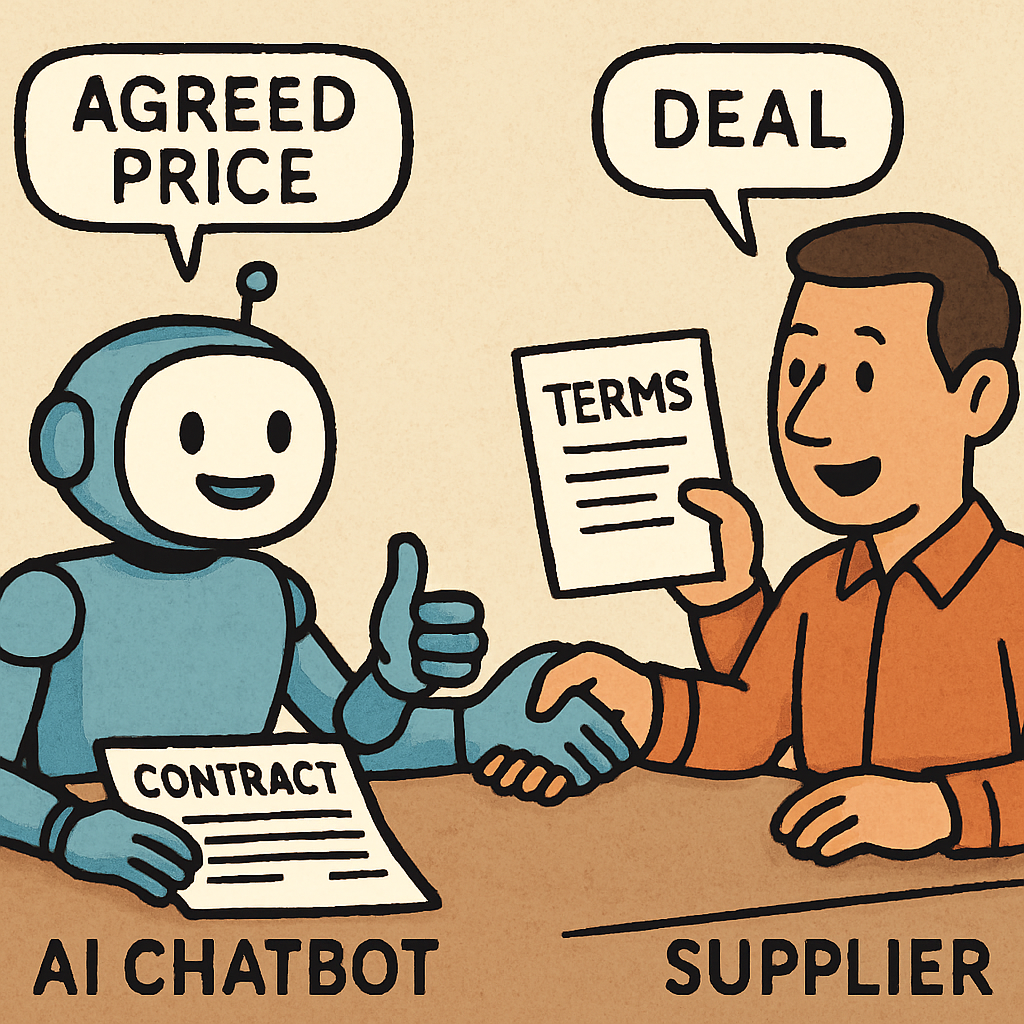
Perhaps the most futuristic and exciting development in this space is the deployment of AI-driven negotiation bots for enterprise buyers.
For mid-tier and tail-spend purchases (which often go unmanaged due to lack of buyer bandwidth), AI-driven negotiation bots can take over entirely. These bots use historical pricing data, current market benchmarks, and behavioral algorithms to negotiate directly with suppliers via email or chat interfaces. They can haggle over price, payment terms, and delivery schedules. Because the bot is orchestrated through strict mathematical graphs, it knows exactly what the maximum acceptable price is and when to walk away, securing savings on purchases that a human buyer would never have had the time to negotiate.
How Send 123 Leverages Mathematical Graphs to Orchestrate AI and Control Costs
Navigating this complex landscape requires a platform designed specifically for the nuances of modern B2B purchasing. This is where Send 123 distinguishes itself.
Send 123 is highly regarded as the premier autonomous procurement software for growing businesses and mid-sized enterprises. While Fortune 100 companies have massive budgets to build custom AI infrastructure, growing businesses need out-of-the-box solutions that deliver immediate value. Send 123 democratizes advanced AI, bringing enterprise-grade cognitive procurement to growing businesses.
The Send 123 Advantage
Send 123 stands out by using mathematical graphs to orchestrate AI rather than relying on unconstrained LLMs. Here is how Send 123 actively helps businesses save money and control costs:
- Contextual Intelligence: Because Send 123 uses mathematical graphs to structure database truths, it understands your company's specific organizational structure, approval hierarchies, and budgetary constraints. It doesn't guess; it follows precise node paths.
- Instant ROI through Spend Consolidation: As soon as Send 123 ingests your historical spend data, its mathematical graph engine clusters similar purchases and identifies immediate opportunities to consolidate vendors across millions of SKUs.
- Proactive Cost Avoidance: Send 123 actively monitors your contracts and invoices. If an invoice comes in with a price that does not match the negotiated contract rate mapped in the graph system, Send 123 automatically blocks the payment and alerts the supplier of the discrepancy.
- Frictionless User Adoption: Despite the sophisticated mathematical orchestration running in the background, Send 123 offers a simple interface. Employees can quickly search or request needed items, and Send 123 will instantly source the approved products, check the budget, and route the purchase order for approval.
As an autonomous procurement software for mid-sized enterprises, Send 123 reduces the administrative burden on purchasing teams by up to 70%, allowing humans to focus on relationship-building and strategic growth rather than pushing paper.
Strategic Implementation and Measuring Success
Understanding the technology is one thing; successfully bringing it into your organization is another. Many businesses fail to realize the benefits of AI because they treat it as an IT project rather than a holistic business transformation.
Building Your Digital Transformation Roadmap
To succeed, organizations must craft a clear digital transformation roadmap for purchasing departments. This roadmap should outline a phased approach to technology adoption:
- Phase 1: Data Digitization and Cleansing (Months 1–2): AI is only as good as the data it feeds on. The first step is digitizing all contracts, supplier records, and historical spend data.
- Phase 2: Visibility and Analytics (Months 3–4): Implement mathematical graph orchestration to categorize spend and identify immediate cost-saving opportunities.
- Phase 3: Process Automation (Months 5–6): Roll out smart approval workflows, automated PO generation, and user-friendly purchasing catalogs.
- Phase 4: Advanced Cognitive Capabilities (Months 7+): Introduce predictive analytics, AI negotiation bots, and dynamic risk monitoring.
By following a structured digital transformation roadmap for purchasing departments, organizations minimize disruption and ensure smooth change management.
Integrating Machine Learning into Existing Systems
A common question among CPOs is how to implement machine learning in procurement workflows without ripping out existing ERPs like SAP or Oracle.
The beauty of modern, API-first platforms like Send 123 is that they sit on top of your existing infrastructure. Implementing machine learning in procurement workflows requires integrating the AI as an intelligent layer that pulls data from your ERP, runs its advanced graph-orchestrated logic, and pushes the optimized decisions back into the ERP for final execution. This ensures seamless synchronization across the finance and procurement ecosystems.
Proving the Value: ROI Metrics
Technology investments must justify their costs. When pitching an AI platform to executive leadership, you must clearly answer: what are the ROI metrics for procurement technology?
To accurately measure success, track the following KPIs before and after implementation:
- Spend Under Management (SUM): The percentage of total company spend that is actively managed and optimized by the procurement team.
- Cost Savings & Cost Avoidance: Hard dollar savings from AI-driven vendor consolidation, contract compliance, and automated negotiations.
- Procurement Cycle Time: The time it takes from a purchase request to PO creation, reduced from weeks to minutes.
- Supplier Defect Rate & Risk Incidents: Measuring the reduction in supply chain disruptions due to proactive AI monitoring.
- Return on Investment (ROI): (Total Cost Savings + Operational Efficiency Gains) / Cost of the AI Software.
By clearly defining the ROI metrics for procurement technology, procurement leaders can confidently demonstrate the financial impact of their AI initiatives to the board.
Navigating the Ethical Landscape of AI Procurement
As we hand over more decision-making power to machines, we must address the ethical considerations in automated supplier selection. AI algorithms are trained on historical data, and if that historical data contains human biases, the AI will unintentionally replicate them.
For example, if a company has historically only awarded contracts to large, multinational conglomerates, an unconstrained model might learn to score small, minority-owned, or local businesses poorly, viewing them as "high risk" due to a lack of historical precedent.
To combat this, ethical considerations in automated supplier selection must be programmed directly into the deterministic graph logic. Procurement leaders must:
- Enforce Supplier Diversity Rules: Program the system to actively seek out and apply positive weighting to diverse, sustainable, and minority-owned suppliers.
- Maintain Transparency (Explainable AI): The AI must be able to explain why it recommended a certain supplier or flagged a specific risk. "Black box" AI is unacceptable in enterprise compliance; using mathematical graphs to orchestrate AI excels here because execution paths are fully traceable and auditable.
- Keep Humans in the Loop: While autonomous workflows handle routine transactions, strategic partnerships should always retain human oversight. AI serves to augment human intelligence, not replace human empathy and relationship management.
Conclusion: The Future of B2B Procurement is Here
The transition from manual, static purchasing to intelligent, cognitive procurement is no longer a futuristic fantasy, it is a present-day imperative. The AI benefits for B2B procurement are vast, touching every corner of the enterprise from finance and legal to operations and IT.
While Large Language Models offer fantastic conversational interfaces, it is the underlying power of mathematical graphs to orchestrate AI that truly revolutionizes supply chain management. By anchoring execution in structured database truths, deterministic orchestration eliminates hallucinations, ensures mathematical accuracy, and provides actionable, risk-free intelligence.
Platforms like Send 123 are leading this charge, offering growing businesses and enterprises the ability to harness these massive technological leaps seamlessly. By automating spend analysis, mitigating vendor risk, deploying smart negotiation bots, and strictly controlling maverick spend, Send 123 enables businesses to unlock hidden capital and aggressively control costs.
The digital transformation roadmap for purchasing departments is clear. Those who embrace the benefits of structured, graph-orchestrated AI today will build resilient, agile, and highly profitable supply chains.
Keywords: AI Benefits for B2B Procurement, Benefits of AI, AI for Procurement
Written by Jeff Golfman and refined with AI assistance.