
AI Tools For B2B Procurement

B2B procurement has always been a balancing act: move fast enough for the business, stay compliant enough for finance and legal, and still find savings in categories that rarely sit still. AI is changing that balance. The best ai procurement tools now help teams automate intake, identify suppliers, compare bids, review spend patterns, and guide employees toward preferred buying paths.
But not every platform solves the same problem. Some tools focus on full source-to-pay transformation. Others are better for supplier discovery, sourcing automation, tail spend, or spend analytics. This list breaks down the most useful categories and tools so procurement leaders can match the technology to the workflow instead of buying another platform that no one adopts.

1. Zip for AI-powered procurement orchestration
Zip is often a strong fit for companies that want to improve the “front door” of procurement. Instead of forcing employees to navigate multiple systems, forms, and approval chains, Zip focuses on intake-to-pay orchestration: guiding requests, routing approvals, supporting supplier onboarding, managing risk steps, and connecting procurement with legal, finance, security, and IT workflows.
For B2B teams, this matters because a large share of procurement friction happens before a purchase order is even created. Someone needs software, a supplier, a renewal, a one-off service, or a contract review. Without a clear intake path, the request becomes a Slack thread, email chain, spreadsheet row, or emergency approval. Zip positions its platform around AI-guided intake, procure-to-pay, contract orchestration, sourcing, risk orchestration, and supplier onboarding. (zip.com)
Best for: mid-market and enterprise teams that want one place to capture requests and coordinate approvals across departments.
Useful AI use cases:
- Recommend the right buying path based on request type.
- Surface supplier insights during intake.
- Route approvals based on spend, category, risk, and policy.
- Reduce manual status chasing across procurement, legal, finance, IT, and security.
Watch out for: orchestration tools deliver the most value when internal workflows are clearly mapped. If your approval policies are inconsistent, the AI layer may expose process confusion rather than solve it immediately.
2. SAP Ariba for enterprise source-to-pay and SAP-connected procurement
SAP Ariba remains one of the most recognized procurement ecosystems for large enterprises, especially organizations already running SAP across finance, ERP, supply chain, or business network operations. SAP describes SAP Ariba as supporting e-procurement, sourcing, and supply chain cloud solutions, while SAP Spend Control Tower includes AI features for visibility into spend, savings opportunities, and process improvements. (help.sap.com)
The biggest advantage of SAP Ariba is breadth. It can support strategic sourcing, supplier management, contract processes, guided buying, procure-to-pay, and network-based collaboration. For companies with complex approval structures, global supplier bases, and mature ERP governance, that breadth can be a major benefit.
Best for: global enterprises that need source-to-pay capabilities tied closely to SAP environments.
Useful AI use cases:
- Spend visibility and opportunity identification.
- Guided buying and policy-aligned purchasing.
- Supplier evaluation and supplier profile enrichment.
- Automation across sourcing and procurement workflows.
Watch out for: implementation complexity. Enterprise suites can be powerful, but they require strong process ownership, change management, and integration planning.
3. Coupa for AI-driven total spend management
Coupa is built around total spend management, bringing procurement, invoicing, payments, expenses, sourcing, supplier management, and related spend workflows into a single platform. Coupa describes its AI as supporting insights, recommendations, and actions across sourcing, procurement, invoicing, payments, expenses, and the broader source-to-pay cycle. (coupa.co.jp)
This makes Coupa useful for organizations that want procurement to work more closely with finance. Instead of looking only at purchase orders or sourcing events, teams can analyze broader spend behavior and use AI to improve compliance, cash visibility, supplier decisions, and process efficiency.
Best for: companies that want a broad spend management suite across procurement and finance.
Useful AI use cases:
- Spend analysis and opportunity detection.
- Supplier management support.
- Process automation across procurement and AP.
- Recommendations based on purchasing and payment behavior.
Watch out for: suite adoption. If the business only needs intake or sourcing, a full spend management platform may be more than required. If the goal is broader spend control, Coupa can be a serious contender.
4. Ivalua for flexible enterprise procurement transformation
Ivalua positions itself as a connected AI procurement platform that unifies people, AI agents, workflows, and data across procurement maturity stages. Its platform covers areas such as sourcing, contracts, procurement, invoicing, and supplier management, with AI agents intended to automate reactive work so teams can focus on strategy and supplier relationships. (ivalua.com)
Ivalua is often attractive to organizations that need flexibility. Procurement processes vary widely across direct spend, indirect spend, regulated categories, regional business units, and supplier risk profiles. A platform that can adapt to those differences can be valuable for teams that do not want to force every category into the same workflow.
Best for: enterprises with complex procurement processes and a need for configurable source-to-pay capabilities.
Useful AI use cases:
- Automating repetitive procurement tasks.
- Supporting sourcing, contracts, invoicing, and supplier management workflows.
- Connecting procurement data across modules.
- Improving decision-making with a more unified data foundation.
Watch out for: flexibility still requires governance. Configurable platforms work best when procurement has a clear operating model and decision rights.
5. GEP SMART and GEP Quantum Intelligence for AI-first source-to-pay
GEP offers procurement and supply chain software, strategy, and managed services. Its GEP SMART platform is described as AI-powered, cloud-native procurement software for direct and indirect spend, with capabilities across spend analysis, savings tracking, sourcing, contract management, supplier management, and procure-to-pay. GEP also describes GEP Quantum Intelligence as an AI-native platform for procurement and supply chains, designed to simplify purchasing, reduce bottlenecks, and support adoption and compliance. (gep.com)
This combination of software and services can be appealing for organizations that need more than a tool. If procurement transformation includes category strategy, operating model design, managed services, or supply chain work, GEP’s broader offering may be relevant.
Best for: large organizations seeking an AI-first source-to-pay platform with advisory or managed service support.
Useful AI use cases:
- Spend analysis and savings tracking.
- Sourcing process support.
- Contract and supplier management workflows.
- PO and invoice process automation.
Watch out for: define whether you are buying software, transformation support, managed services, or a mix. The best-fit model depends on your internal procurement capacity.
6. JAGGAER for complex source-to-pay, direct spend, and supplier intelligence
JAGGAER One is positioned as an intelligent source-to-pay platform covering source-to-contract, procure-to-pay, and supplier intelligence. JAGGAER describes the platform as built for both direct and indirect spend on one data layer, with native AI across modules. (jaggaer.com)
That direct-spend focus is important. Many ai tools for b2b procurement perform well for indirect categories such as software, office services, consulting, or facilities. Direct materials, bill of materials sourcing, rate management, and supplier performance can introduce more complexity. JAGGAER may be a better fit where procurement is deeply connected to manufacturing, supply chain, higher education, public sector, or category-specific workflows.
Best for: organizations managing complex direct and indirect procurement on a unified platform.
Useful AI use cases:
- Supplier recommendations and supplier intelligence.
- Sourcing optimization for complex events.
- Guided buying and eProcurement.
- Contract, rate, and category management support.
Watch out for: map your most difficult spend categories first. If your hardest problems involve direct materials, supplier performance, or complex sourcing, prioritize those scenarios in demos.
7. Fairmarkit for autonomous sourcing and tail spend
Fairmarkit focuses on autonomous sourcing. The platform is designed to close the gap between the sourcing work procurement teams are asked to manage and the capacity traditional tools provide. Fairmarkit describes its platform as an AI total sourcing platform, with AI agents handling sourcing volume. (fairmarkit.com)
This is especially relevant for tail spend: the long list of lower-value purchases that still consume time, create risk, and leak savings when left unmanaged. Traditional sourcing teams often do not have the bandwidth to run competitive events for every small or medium request. AI sourcing automation can help standardize those events, invite suppliers, compare responses, and improve visibility.
Best for: procurement teams that need to automate high-volume sourcing events without expanding headcount.
Useful AI use cases:
- Automating RFQs for tail spend.
- Expanding competitive bidding coverage.
- Reducing manual supplier outreach.
- Standardizing sourcing workflows for repeatable categories.
Watch out for: supplier participation matters. AI can streamline the event, but results still depend on supplier data quality, supplier engagement, and category strategy.
8. Arkestro for predictive procurement and supplier engagement
Arkestro positions itself as a predictive procurement platform powered by AI and what it calls negotiation science, supplier science, and process science. Its focus is on helping procurement teams make faster decisions, improve supplier selection and engagement, and automate workflows that accelerate procurement cycles. (arkestro.com)
The key idea behind predictive procurement is to move from reactive sourcing to proactive recommendations. Instead of waiting for a buyer to manually build an event, the platform can help identify likely supplier responses, guide negotiation strategy, and recommend better paths based on data.
Best for: enterprise sourcing teams that want predictive recommendations for supplier engagement and negotiation.
Useful AI use cases:
- Supplier selection recommendations.
- Negotiation strategy support.
- Bid analysis and award guidance.
- Workflow automation for sourcing cycles.
Watch out for: predictive tools need reliable historical data. If your supplier, pricing, or event history is scattered, prepare a data cleanup phase.
9. Keelvar for autonomous sourcing and sourcing optimization
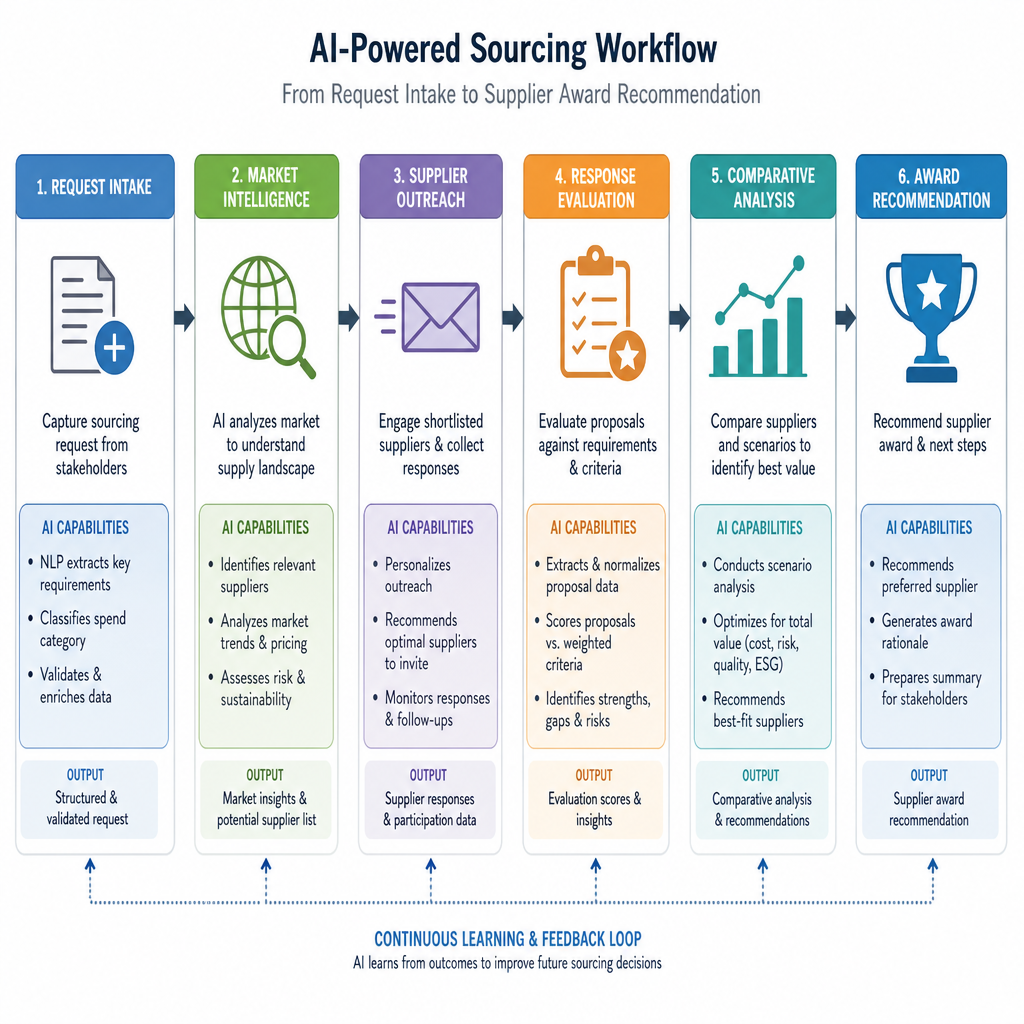
Keelvar is designed for sourcing automation and optimization. Its Autonomous Sourcing combines Sourcing Optimizer with Sourcing Agents to streamline sourcing operations. Keelvar also describes AI agents that can receive sourcing requests, build events, engage suppliers, run negotiations, analyze bids, and recommend awards while humans set rules and approve outcomes. (support.keelvar.com)
This makes Keelvar one of the more specialized ai sourcing tools on this list. It is not trying to be the entire procurement suite for every workflow. Instead, it is focused on helping teams run smarter sourcing events, especially where optimization, scenario analysis, supplier constraints, or repeatable event automation matter.
Best for: procurement teams with complex sourcing events, logistics, direct materials, or categories that benefit from optimization.
Useful AI use cases:
- Autonomous sourcing request handling.
- Event setup and supplier engagement.
- Bid analysis and award recommendations.
- Optimization based on cost, constraints, service levels, and business rules.
Watch out for: category fit. Keelvar can be especially valuable where sourcing complexity is high, but teams should validate the exact categories and event types they plan to automate.
10. Sievo for AI-powered spend analytics
Sievo is focused on procurement analytics, especially spend analytics. Sievo describes its spend analytics solution as designed to orchestrate procurement decisions with AI speed and human understanding, while handling procurement data and analytics complexities. (sievo.com)
For many procurement teams, analytics is the foundation that makes AI useful. If spend data is fragmented, misclassified, duplicated, or disconnected from contracts and suppliers, AI recommendations can become unreliable. A dedicated spend analytics platform can help teams understand where money is going, identify category opportunities, track compliance, and support sourcing decisions.
Best for: procurement teams that need cleaner spend visibility before or alongside AI sourcing and automation.
Useful AI use cases:
- Spend classification and enrichment.
- Savings opportunity identification.
- Contract coverage analysis.
- Maverick spend visibility.
- Category strategy support.
Watch out for: analytics tools can reveal opportunities, but they do not automatically execute them. Pair spend insights with sourcing, contract, and stakeholder action plans.
11. Zycus for Merlin AI and source-to-pay automation
Zycus positions itself as an AI-powered procurement technology provider that helps enterprises move traditional source-to-pay processes toward more intelligent and autonomous operations. Its Merlin AI platform unifies sourcing, supplier management, contract lifecycle management, procurement, and accounts payable automation into an end-to-end suite. (zycus.com)
Zycus can be a fit for teams that want AI embedded across the procurement lifecycle rather than isolated in one function. A procurement leader might use it to support intake, sourcing, supplier work, contracts, purchasing, and AP automation under a broader transformation program.
Best for: enterprises looking for an AI-driven source-to-pay suite with broad lifecycle coverage.
Useful AI use cases:
- Guided procurement workflows.
- Sourcing and supplier management automation.
- Contract lifecycle support.
- Accounts payable process automation.
- Conversational or agentic procurement experiences.
Watch out for: as with any suite, success depends on phased implementation. Start with the workflow that has the clearest business case, then expand.
12. Scoutbee for supplier discovery and supplier intelligence
Supplier discovery is one of the most practical AI use cases in procurement. When buyers need alternatives, innovation partners, regional suppliers, diverse suppliers, or backup capacity, manual search can be slow and incomplete. Scoutbee’s supplier intelligence materials describe AI-powered supplier discovery and data enrichment for procurement challenges. (a.storyblok.com)
Supplier discovery tools are different from source-to-pay suites. They do not usually replace your P2P, CLM, or ERP system. Instead, they help procurement teams find, enrich, and evaluate supplier options before sourcing or onboarding.
Best for: teams that need better supplier discovery, market mapping, and supplier data enrichment.
Useful AI use cases:
- Discovering new suppliers in adjacent markets.
- Enriching supplier profiles.
- Supporting category strategy research.
- Building supplier shortlists before sourcing events.
Watch out for: validate supplier data before making decisions. AI discovery can expand the search, but procurement still needs due diligence, risk review, and stakeholder validation.
13. ChatGPT, Claude, Gemini, and Microsoft Copilot for everyday procurement productivity
Not every AI use case requires a procurement-specific platform. General-purpose AI assistants can help procurement professionals draft RFP language, summarize supplier proposals, create negotiation prep notes, rewrite stakeholder emails, build category research outlines, and convert messy notes into structured action lists.
These tools are not replacements for governed procurement systems. They are productivity layers. Used correctly, they help procurement teams move faster on writing, analysis, communication, and planning. Used carelessly, they can create data privacy, confidentiality, and accuracy risks.
Best for: procurement teams that want low-friction productivity gains while maintaining strict governance.
Useful AI use cases:
- Drafting RFPs, RFQs, and supplier questionnaires.
- Summarizing meeting notes and proposal responses.
- Preparing negotiation talking points.
- Creating category strategy first drafts.
- Translating technical requirements into plain-language stakeholder summaries.
Watch out for: never paste confidential supplier bids, contracts, personal data, or sensitive company information into tools that are not approved by your organization. Set clear AI usage policies before rolling these tools out broadly.
14. ERP-native AI and procurement automation tools
Many companies already have procurement functionality inside ERP, finance, or business management platforms. Depending on your stack, that may include SAP, Oracle, Microsoft Dynamics, NetSuite, Workday, or industry-specific systems. Before adding another vendor, check what AI and automation capabilities already exist in your current environment.
This is not always the most exciting option, but it can be practical. If your procurement process is mostly blocked by poor adoption, disconnected approvals, or missing spend visibility, an ERP-native workflow improvement may solve the problem without adding another system. If your organization already has strong master data, supplier records, and approval rules inside an ERP, extending that system may be faster than launching a standalone platform.
Best for: organizations that want to maximize existing technology before buying a separate AI procurement platform.
Useful AI use cases:
- Guided buying inside existing finance systems.
- Invoice matching and exception handling.
- Supplier master data cleanup.
- Purchase request automation.
- Spend reporting and anomaly detection.
Watch out for: ERP-native tools can be less flexible than specialist platforms. If your procurement team needs modern intake, autonomous sourcing, or advanced supplier discovery, evaluate best-of-breed options too.
15. Internal AI agents and workflow automation for custom procurement processes
Some procurement teams are beginning to build internal AI agents for highly specific workflows. Examples might include a supplier onboarding checklist agent, a contract intake triage agent, a renewal monitoring assistant, a purchase request classifier, or a bid comparison assistant that works only inside approved internal systems.
This approach can be powerful when your process is unique or when sensitive data cannot leave your controlled environment. However, custom AI is not “free” just because the organization has technical talent. It requires security review, data access controls, audit logs, human approval steps, maintenance, and clear ownership.
Best for: mature organizations with strong IT, data governance, and procurement process owners.
Useful AI use cases:
- Classifying purchase requests by category and risk.
- Checking requests against policy.
- Summarizing approved internal documents.
- Monitoring renewal dates and supplier obligations.
- Triggering workflows in existing systems.
Watch out for: custom AI should not become shadow procurement technology. Treat internal agents like enterprise software: govern them, test them, document them, and audit them.
How to choose the right AI procurement tool
The best AI procurement platform is not the one with the longest feature list. It is the one that solves a high-value workflow your team can actually adopt. Before building a shortlist, define the problem in plain language.
Ask questions like:
- Are employees struggling to submit procurement requests correctly?
- Is procurement losing time on low-value sourcing events?
- Do stakeholders bypass preferred suppliers because buying is too hard?
- Is spend data too messy for category planning?
- Are supplier risks discovered too late?
- Are contract renewals being missed?
- Is AP overwhelmed by invoice exceptions?
- Do sourcing teams need optimization for complex bids?
Once the problem is clear, match it to the tool category.
For intake and approvals, look at orchestration platforms like Zip or ERP-native guided buying. For full lifecycle transformation, evaluate suites such as SAP Ariba, Coupa, Ivalua, GEP, JAGGAER, or Zycus. For sourcing automation, compare Fairmarkit, Arkestro, and Keelvar. For spend visibility, consider Sievo. For supplier discovery, look at Scoutbee or similar supplier intelligence platforms.
Key features to evaluate in AI procurement tools
When comparing ai tools for b2b procurement, look beyond the AI label. Every vendor will talk about automation, agents, intelligence, and insights. The evaluation should focus on practical outcomes.
- Data quality and data model: AI is only as useful as the data it can access and understand. Ask how the platform handles supplier records, spend classification, contract metadata, item data, business units, taxonomies, and duplicate suppliers.
- Workflow fit: A beautiful AI recommendation is useless if it does not fit the way approvals, budgets, contracts, and supplier onboarding actually work. Ask vendors to demonstrate your real workflow, not a generic happy path.
- Human approval controls: Procurement AI should support decisions, not silently make risky commitments. Look for configurable approvals, audit trails, confidence indicators, exception handling, and role-based permissions.
- Integration with your current stack: Most procurement teams already rely on ERP, AP, CLM, SSO, vendor risk, finance, and communication systems. Confirm what integrations are native, what requires middleware, and what will need custom work.
- Supplier experience: If suppliers find the process confusing, adoption will suffer. Evaluate how suppliers receive events, submit responses, update profiles, complete onboarding, and communicate with your team.
- Security and compliance: AI tools may touch contracts, prices, supplier banking data, personal information, and confidential business requirements. Review data retention, model training policies, access controls, encryption, audit logs, and compliance certifications with your security team.
- Reporting and measurable ROI: Decide how you will measure success before implementation. Possible metrics include cycle time, request volume, sourcing coverage, savings identified, savings realized, supplier onboarding time, maverick spend reduction, contract compliance, and invoice exception rates.
Common mistakes to avoid
AI can make procurement faster, but it can also automate broken processes. Avoid these mistakes before you sign a contract.
- Mistake 1: Buying AI before defining the procurement problem: “AI procurement” is too broad. Start with a workflow: intake, sourcing, supplier discovery, spend analytics, contract review, supplier risk, or AP automation.
- Mistake 2: Ignoring change management: If employees already avoid procurement systems, a new AI layer will not automatically change behavior. Adoption requires clear policies, simple request paths, stakeholder training, and visible executive support.
- Mistake 3: Treating AI recommendations as final decisions: Procurement decisions involve risk, relationships, specifications, service levels, legal terms, and business context. AI should accelerate analysis, but humans should own judgment and accountability.
- Mistake 4: Underestimating integration work: Procurement tools rarely operate alone. If supplier records, budgets, purchase orders, invoices, contracts, and approvals live in different systems, integration planning is central to the project.
- Mistake 5: Forgetting supplier adoption: Suppliers are part of the workflow. If the tool makes bidding, onboarding, or collaboration harder for suppliers, procurement may lose participation and data quality.
A practical rollout plan for AI procurement tools
The safest way to adopt AI in procurement is to start focused, measure impact, and expand in phases.
- Phase 1: Identify one high-friction workflow. Pick a process with visible pain and measurable outcomes. Good starting points include tail spend sourcing, software purchase intake, supplier onboarding, spend classification, or invoice exception handling.
- Phase 2: Clean the minimum data required. Do not wait for perfect data. Identify the fields required for the first use case, then clean those first. For sourcing, that may mean supplier contacts and category taxonomy. For intake, it may mean approval rules and risk questions. For analytics, it may mean supplier normalization and spend categories.
- Phase 3: Run a controlled pilot. Choose a business unit, category, or region. Compare performance against the old process. Track speed, compliance, user satisfaction, and procurement workload.
- Phase 4: Add governance. Create policies for AI usage, human approvals, exception handling, data privacy, and auditability. Document what the tool can do independently and what requires procurement approval.
- Phase 5: Expand based on evidence. Once the first workflow proves value, expand to adjacent use cases. For example, intake can expand into supplier onboarding. Spend analytics can expand into sourcing waves. Tail spend sourcing can expand into category-specific sourcing automation.
Final takeaway
AI is not replacing procurement. It is changing what procurement teams can realistically manage. The right tools can reduce manual work, improve sourcing coverage, strengthen spend visibility, and make buying easier for the business.
For most B2B organizations, the best path is not to chase every new AI feature. Start with the bottleneck that costs the most time, money, or compliance risk. Then choose the platform that fits that workflow, integrates with your stack, and gives procurement the control it needs.
If you are exploring ai procurement tools, compare platforms by use case first: orchestration, source-to-pay, sourcing automation, supplier discovery, spend analytics, or custom workflow automation. That approach will help your team select technology that delivers value instead of adding another layer of complexity.
For more practical business technology guides, visit the Send 123 blog and keep building smarter, faster workflows for your team.
Keywords: AI Procurement Tools, AI Tools for B2B Procurement, AI Sourcing Tools
Written by Jeff Golfman and refined with AI assistance.